To speak of Sicilian architecture is to speak of continuity and transformation. Few places in Europe offer such a layered and eloquent dialogue between cultures — each civilization leaving not a trace, but a presence.
The Classical Horizon
Sicily’s architectural identity begins with the legacy of the ancient Greeks and Romans, whose vision of harmony, proportion, and monumentality still defines parts of the island’s landscape.
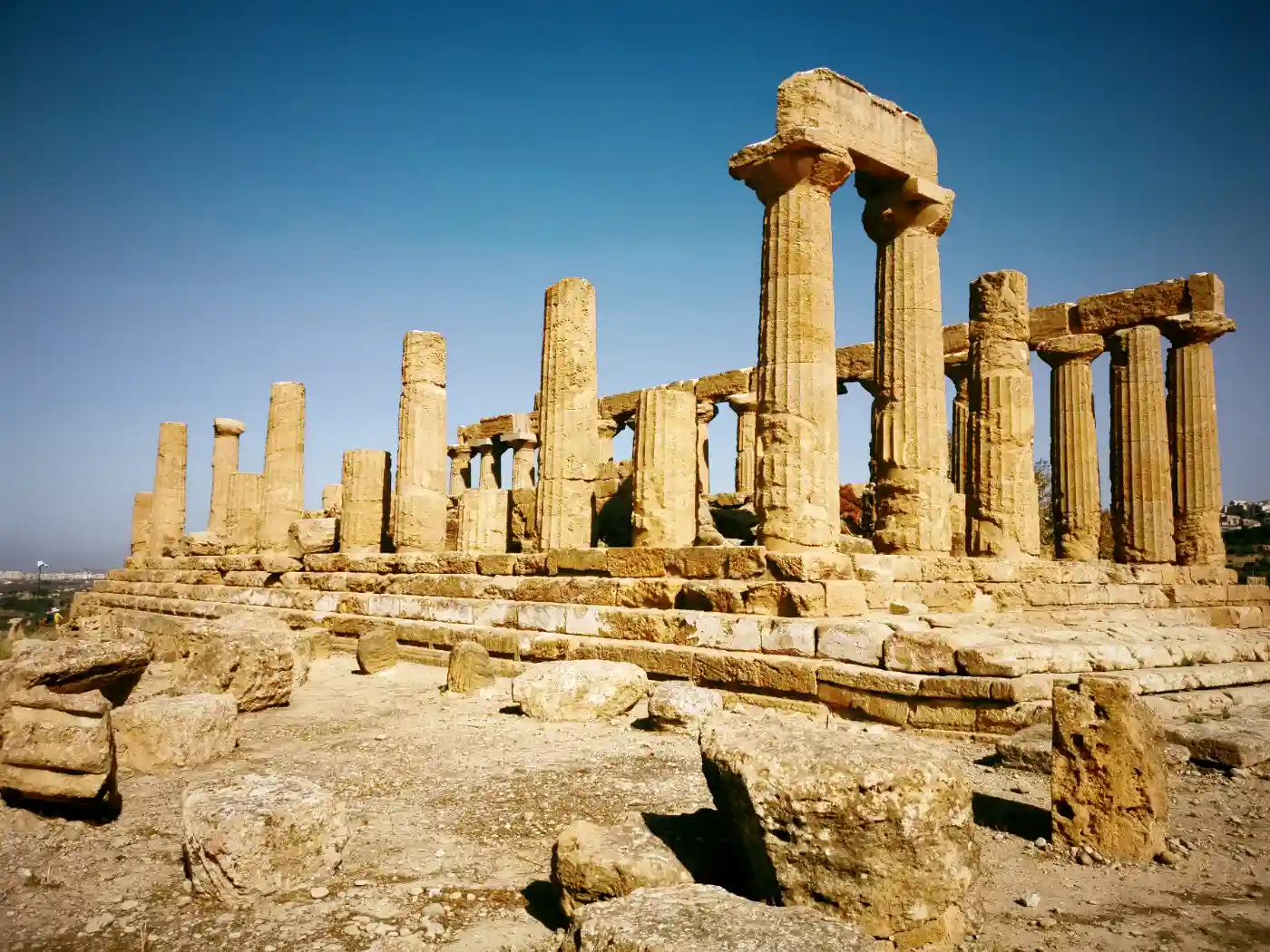
In Agrigento, the Valley of the Temples rises in quiet grandeur. These Doric structures, poised against the Mediterranean light, evoke not ruins but permanence — an enduring idea of balance between human creation and nature. Temples such as Concordia and Juno stand among the best-preserved in the ancient world, their clarity of form still strikingly modern.
Greek influence extended across cities like Selinunte and Segesta, where sacred architecture was conceived not only as religious space, but as a statement of civic identity. The Romans, in turn, introduced new spatial concepts — villas, amphitheatres, and infrastructures — visible in sites such as the Villa Romana del Casale, where architecture and decoration merge into a sophisticated expression of imperial life.
The Arab-Norman Synthesis
Nowhere is Sicily’s cultural complexity more refined than in Palermo, where centuries of coexistence between Norman, Arab, and Byzantine cultures produced an architectural language unique in Europe.
Within Palermo Cathedral and the luminous Palatine Chapel, this synthesis reaches its highest expression. Byzantine mosaics shimmer in gold, depicting sacred hierarchies with ethereal stillness; Islamic artisanship reveals itself in intricate geometric patterns, muqarnas ceilings, and refined decorative rhythms; while Norman architecture provides structural clarity and monumentality.
The result is neither hybrid nor juxtaposition, but a true fusion — an architecture that speaks multiple cultural languages simultaneously, embodying a vision of power that was also deeply inclusive.
The Baroque Imagination
The earthquake of 1693 marked a turning point in Sicilian architectural history. Entire cities in the southeast were destroyed and subsequently rebuilt in a style that transformed tragedy into artistic expression.
In Noto, Ragusa, and Modica, architecture becomes scenography. Facades are no longer static surfaces, but dynamic compositions: concave and convex forms, elaborate balconies supported by expressive masks, and a rhythmic interplay of light and shadow.
What distinguishes Sicilian Baroque from its Roman counterpart is precisely this theatricality combined with local materiality. The warm golden limestone, the dramatic topography of the towns, and a certain freedom of expression give Sicilian Baroque a more sensual, almost narrative quality — less restrained, more immersive.
Modern Echoes
Sicily’s architectural dialogue did not end with the Baroque. In the late 19th and early 20th centuries, the island embraced modernity while maintaining a strong sense of identity.
In Palermo, the Liberty style (Italian Art Nouveau) found one of its most refined interpreters in Ernesto Basile. His work reflects a sophisticated blend of innovation and tradition, visible in elegant villas and urban spaces.
Landmarks such as the Teatro Massimo — one of the largest opera houses in Europe — and the iconic Villa Igiea embody this cosmopolitan spirit. Here, architecture becomes a statement of cultural ambition, bridging Sicily’s historical depth with a modern European vision.
Experiencing Architecture as Narrative
Architecture in Sicily is not simply to be seen — it is to be read. Each stone, each decorative element, each spatial choice reflects layers of history, power, and cultural exchange.
For the cultivated traveler, the most meaningful way to experience this richness is through private architectural tours in Sicily, designed with expert guidance and a deep curatorial approach. Beyond the well-known landmarks, such itineraries open doors to aristocratic palaces, hidden courtyards, and lesser-known sites — places where architecture reveals its more intimate dimension.
Whether exploring Baroque towns at sunrise, tracing Arab-Norman influences through Palermo, or walking among ancient temples at dusk, these journeys offer not only knowledge, but perspective — transforming architecture into a living, unfolding narrative.