
When Michelangelo Merisi da Caravaggio arrived in Sicily in 1608, he was no longer the celebrated master of Rome, but a fugitive: restless, wounded, and profoundly transformed. What he created on the island belongs to the most intense and introspective phase of his career.
Caravaggio’s Sicilian sojourn was brief, yet artistically seismic. Moving between Syracuse and Messina, he painted with a new austerity: his compositions stripped of ornament, his figures emerging from darkness with an almost existential gravity.
Where to See Caravaggio’s Paintings in Sicily
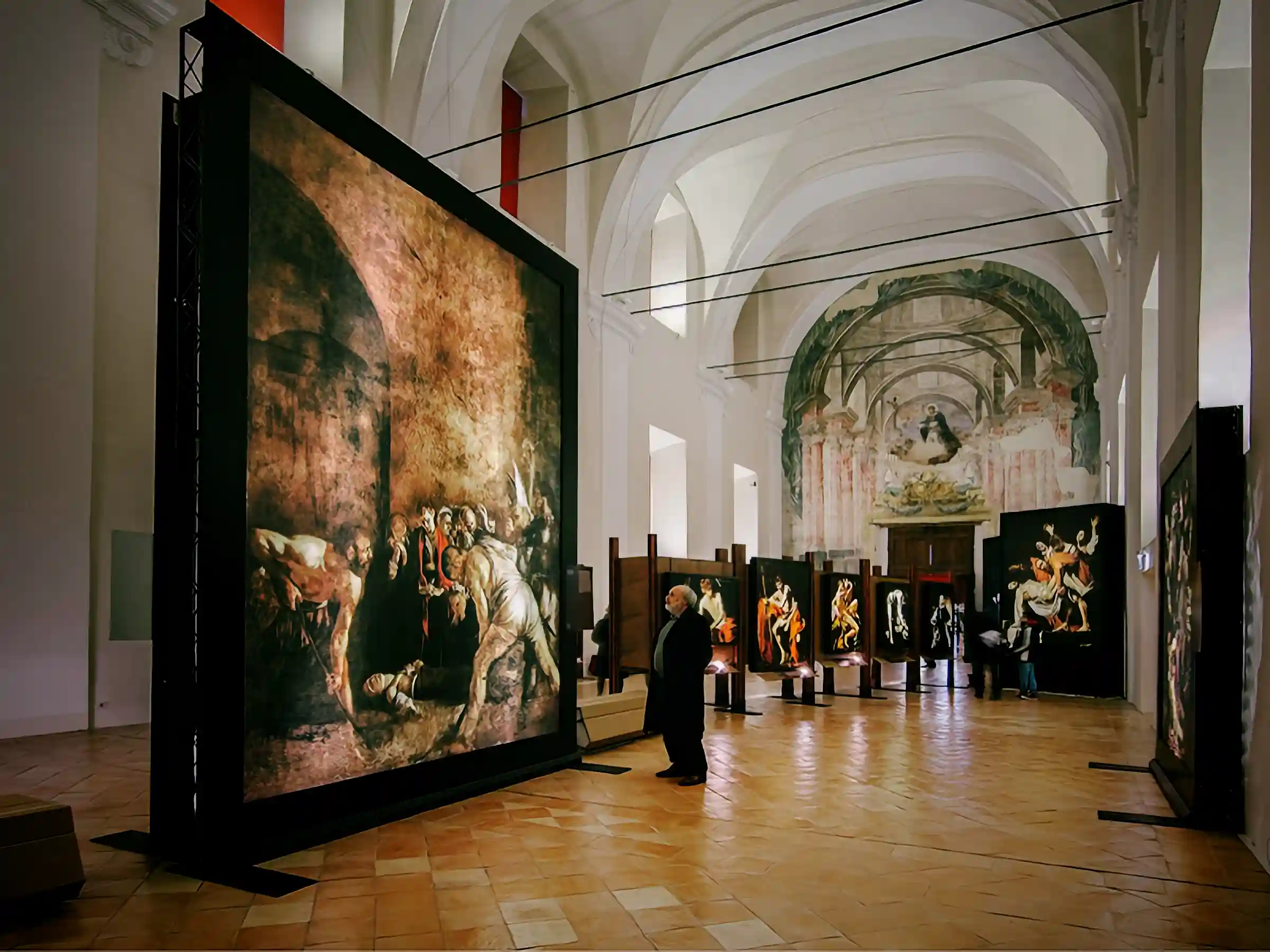
Syracuse — The Burial of Saint Lucy
Now housed in the Church of Santa Lucia al Sepolcro, this vast canvas is striking in its silence. The space feels emptied, the human presence fragile. Saint Lucy is not idealized, as was customary in 17th-century representations of saints, but depicted as a lifeless body, laid on the ground while two men dig her grave and a small crowd gathers in subdued mourning.
The painting is rich in symbolism: the red stole of the priest evokes the blood of martyrdom, while the severe architectural backdrop dominates much of the composition, amplifying a sense of desolation. One does not simply observe this work; one enters it.
Messina — The Raising of Lazarus and The Adoration of the Shepherds
Today preserved at the Museo Regionale di Messina, these works reveal Caravaggio at his most radical. The sacred is rendered through the ordinary: bare feet, worn faces, human vulnerability.
As in Syracuse, space plays a decisive role: vast, austere architectural settings contrast with the immediacy of human emotion. The coldness of the environment heightens the warmth and intensity of the figures, creating a powerful visual and emotional tension that is unmistakably Caravaggio’s late style.
The Story of a Lost Masterpiece
In Sicily, it was once possible to stand before another work by Michelangelo Merisi da Caravaggio, to encounter it intimately, in the quiet of a small oratory in Palermo. The Nativity with St. Francis and St. Lawrence belonged to that rare category of paintings that seem less observed than experienced, suspended between shadow and revelation.
Then, in 1969, it vanished.
The theft — still unresolved — has since entered the realm of legend. Over the decades, speculation has intertwined with history: whispered connections to the Sicilian Mafia, accounts of neglect or destruction, and more elusive suggestions that the painting may yet survive, hidden from view in a private, inaccessible world.
Yet the mystery is not only about its disappearance. Some scholars have long noted that its style diverges from the stark austerity of Caravaggio’s Sicilian works in Syracuse and Messina. This has led to a compelling hypothesis — that the painting may in fact belong to an earlier Roman phase, carrying with it a different light, a different sensibility.
Today, what remains is not the work itself, but its absence — an absence that continues to shape the narrative of Caravaggio in Sicily, lending it a quiet, enduring sense of enigma.
A Journey for the Cultivated Traveler
To follow Caravaggio in Sicily is to trace not only an artistic evolution, but a deeply human narrative — one shaped by exile, urgency, and a relentless search for truth.
For the discerning traveler, one of the most compelling experiences is a private itinerary dedicated to Caravaggio’s works, extending beyond Sicily to include Malta, where the artist’s dramatic life took another decisive turn. Such a journey reveals not only the paintings themselves, but the landscapes, atmospheres, and silences that informed them.